Saturday, January 9, 2010

Project Tiger


OBJECTIVE
The main objective of Project Tiger is to ensure a viable population of tiger in India for scientific , economic , aesthetic , cultural and ecological values and to preserve for all time, areas of biological importance as anatural heritage for the benefit, education and enjoyment of the people. Main objectives under the scheme include wildlife management, protection measures and site specific eco-development to reduce the dependency of local communities on tiger reserve resources .
PAST
Project Tiger was launched in 1973-74 is on of the most successful conservation ventures of all time. The project aims at the conservation of tigers in specially constructed 'tiger reserves'. These represent the bio-geographical area falling in our country. An estimate of the tiger population at the turn of the century was around 40,000. Whereas when the 1st survey was done in 1972, the population came out to be only 1827. To prevent this shrinkage, a national ban on tiger hunting was imposed in 1970 whereas the Wildlife Protection Act came into being in 1972.


the principles on which the tiger reserves were made :-
1. Elimination of all forms of human exploitation and biotic disturbance from the core area and rationalization of activities in the buffer zone.
2. Restricting the habitat management only to repair the damages done to the eco-system by human and other interferences, so as to facilitate recovery of the eco-system to its natural state.
3. Monitoring the faunal and floral changes over time and carrying out research about wildlife.
Initially 9 tiger reserves were established which covered which covered an area 13,017 sq.km. Various reserves are Manas [Assam], Palamau [Bihar], Similipal [Orissa], Corbett [UP], Kanha [MP], Melghat [maharashtra], Bandipur [karnataka], Ranthambore [Rajasthan], Sunderbans [west bengal]. The project is a 'centrally sponsored' scheme were the expenditure is shared equally between the Central and State government. WWF gave an assistance of 1 million $ in the form of equipment, literature and expertise.
PRESENT

Wireless communication system and outstation patrol camps have been developed within the tiger reserves, due to which poaching has declined considerably. Fire protection is effectively done by suitable preventive and control measure Voluntory Village relocation has been done in many reserves, especially from the core, area. In Kanha, Bandipur and Ranthambhore, all the villages have been shifted from the core, and after relocation, the villagers have been provided with alternate agricultural lands and other community benefits.
This has resulted in the improvement of the carrying capacity of the habitat. Live stock grazing has been controlled to a great extent in the tiger reserves. Various compensatory developmental works have improved the water regime and the ground and field level vegetations, thereby increasing the animal density. Research data pertaining to vegetational changes are also available from many reserves. In general, the 'restorative management' and 'intense protection' under 'Project Tiger' have saved many of our eco-typical areas from destruction. The area around the buffer is now contemplated as a zone of multiple use, to bring compatibility between the reserves and the neighbouring communities.

FUTURE
a) Use of Information and Communication technology in Wildlife Protection and Crime Risk Management in Tiger reserves.
b) GIS based digitized database and MIS development/networking in Tiger Reserves:
c) Tiger Habitat & Population Evaluation System for the Indian Sub Continent

A 'Tiger Atlas of India' and a 'Tiger Habitat & Population Evaluation System for the country is being developed using the state- of - the - art technology.
This involves:
Satellite data is being used and classified into vegetation and land use maps on a 1:50,000 scale, with digitized data relating to contour , villages, roads , drainage , administrative boundaries and soil . The spatial layers would be attached with attribute data , viz. human population , livestock population , meteorological data, agricultural information and field data pertaining to wildlife, habitat for evolving regional protocols to monitor tiger and its habitat.

Update News From National Geographic......

Oldest Land-Walker tracks found
The first vertebrates to walk the Earth emerged from the sea 18 million years before than thought, say scientists who have discovered footprints from an 8-foot long prehistoric creature. Dozens of 395 million year old fossil footprints have been rezcently discovered in a former lagoon in South-eastern Poland. The prints were made by Tetrapods [animals with backbones and 4 limbs] and could rewrite the history of when, where, and why fish evolved limbs and first walked onto land, the study says.
The tracks were made by species which had digits or toes on each foot. The footprints vary in size, some being as wide as 10 inches. Track size indicate flat bodied, lizard like creatures 8.2 feet long and with stout legs. These were discovered in an abandoned mountain quarry.


Tuesday, December 29, 2009

Pet of the Month Guinea Pig


A domestic rodent also known as Cavy which is certainly not a pig and hasn't come from Guinea. They originated in the Andes but don't exist in the wild anymore. Guinea Pigs have gained widespread popularity as a household pet, but for ages has been us
ed as a food source and in folk medicine in the groups of South America. Biological experiments on guinea pigs has been carried out since 17th century. The animals are frequently used as a model organism, resulting as 'guinea pig' being a test subject, but have been largely replaced by other rodents such as mice and rats.Its binomial name is Cavia Porcellus. They are a bit large for rodents, weighing between 700-1200g, and measuring 20-25cm
in length. On avg. they live for 4-5 yrs, but may live for as long as 8yrs. According to Guineas bAdd Imageook of world records the longest living guinea pig lived for 14 yrs and 10.5 months.
They live generally in cages, solid or wire mesh are used, though wire mesh cause injuriesand can cause an infection called Bumble-foot. Cubes & Coroplast cages are common nowadays. Cages are lined with shavings of softwood like Red Cedar & Pine but safer beddings can hardwoods [like aspen]. paper products, corn corb materials. They are often messy with their cages and male guinea pigs urinate to mark their territory
. When I had them. this annoyed me a lot......but they were too cute and friiendly to be annoyed with. they were simply awesome...........
Guinea pig sight is not as good as a human, but they have a wider range of vision (about 340°) and see in partial color. They have well-developed senses of hearing, smell, and touch. Vocalization is the primary means of communication between members of the species. Some sounds are:
Wheek: It is a loud noise, also ,produced at general excitement.
Purring: Produced when enjoying time, Eg: In new place, grooming.
Rumbling:Scared, angry, Dominated
Whining: When playing and pursued
Chattering:By gnashing teeth, used to warn
Squeeling: High pitched, sound of discontent, in danger, scared
Health
Grass is its natural diet. Their molars are suited for grinding which grow throughout life. They benefit from eating fresh grass hay [like Timothy hay]. Alfalfa is a good choice as they are happy to eat lots of it at a time. But scientists say that Alfalfa taken in large amounts may cause obesity, as well as bladder stones. Though Alfalfa is a good source of protein, amino acid and fiber. There diet includes Alfalfa, Beetroot & its leaves, Capsicum, Coriander, Lettuce, Rock melon, Broccoli, Asparagus etc. A number of plants are poisonous to guinea pigs, including Bracken, barony, buttercup,Charlock, deadly nightshade, foxglove, hellebore, hemlock, Lily of the Valley, mayweed, monkshood, privet, ragwort, rubhurb, speedwell, toadflax, wild celery. Additionally, any plant which grows from a bulb (e.g., tulip and onion ) is normally considered poisonous.
Guinea Pigs gestation period is on avg. 63-68 days. Because of the large size of the pups ad the long gestation periods the pregnaant sow may become of an eggplant shape. Newborn pups are well developed with hair, teeth, claws and partial eyesight. Sows generally give birth to 1-6 pups, the maximum record being 17.
Male and female don't differ except from general size.Males reach sexual maturity at 3–5 weeks; females can be fertile as early as four weeks and can carry litters before they are adults.Females can become pregnant 6-48 hours after giving birth, but its not hralthy for them to be pregnant constantly.
There are many breeds of the cavy. The common ones are the short haired, Abyssinian, Peruvian, Rex, Silkie, Teddy and Texel. While the rare or upcoming breeds include Alpaca, crested, Coronet, English Merino, Hairless, Ridgeback, Abbyruvian etc.


Guess Which breed is Which & comment ????????????
Human Influence
Originally, he guinea pigs were domesticated by the indigenous Andean people of the Andean highlands for their meat. It was usually reserved for ceremonial meals. But since 1960's they are now common to all people. They make a major part of the diet in countries like Peru & Bolivia, and are still used in some parts of countries like Ecuador and Columbia for food. As they require very less space than livestock and reproduce apparently faster, they didn't take much time to become popular. Another advantage of rearing them than livestock was that they could even survive in the urban environment hence, both urban and rural could have them without difficulty. Guinea pig meat is high on protein and low on fats and cholesterol and is similar to that of a rabbit. They may be fried, broiled, roasted or can be served in the shape of a casserole.
Guinea pigs have been used as research material from as back as the 17th century. Can U imagine dat?????????????? humans just eat and use animals for whatever day want... they drug them, shock them, put them in boiling water and take them 2 death for their own good?????whichever topic i choose, there is always mention of use of that particular specie as meat......................So friends i Wanna raise awareness on these topics n stop cruelty on animals


Thursday, October 22, 2009

Wild Animal Of The Month Dugong

Dugong is a large marine mammal which has been for long hunted for its meat 'n' oil. Many of its population are near extinction. It is concerned Threatened and is Vulnerable. Also called Sea Cow, Sea pig etc., though its Binomial name is Dugong Dugon. I chose this particular threatened beauty to draw interest of u guys that u dont even know how many of the species are threatened due to our causes. This one fascinated me much........
It has a spindle like shaped body with no dorsal fin present, neither any hind limbs. Instead it has fore limbs shaped as paddles used by it for maneuvering itself.

Though being legally protected, the main causes of population decline are still human activities including hunting, habitat degradation, and fishing related fatalities. Slow rate of reproduction and long lives of around 70 make it vulnerable to such fatalities. They are also threatened by storms, parasites as well as
[ though being very big ] natural predators like sharks, killer whales and crocodiles
Location
The Dugong is heavenly dependent on sea-grasses for survival and is thus restricted to the coastal habitats where they grow. The largest Dugong concentrations occur in wide,shallow, protected areas such as bays, mangrove channels, and near inshore islands. Its snout is sharply down turned, which is an adaption for eating the grass. It is the only sirenian in the range, which spans the area of at least 37 countries throughout the Indo-Pacific region. Mainly the dugong is present in the waters of Australia, between the Shark and Moreton Bay.
Eating Habits
Referred as Sea Cows due to mainly feeding on sea grass the dugong is very particular about its diet. Their primary feeding mechanism is uprooting sea grass by digging furrows in the sea bed with the help of their snouts
However, dugongs in Moreton Bay, Australia are omnivorous and due to the decline of the availability of sea gass of their liking. They feed on invertebrates such as polychaetes. As per as waer is concerned, they can go to any fresh water source for drinking. But the problem here is that these are decling and therefore a sharp decline in Dugong population is expected.
Conservation
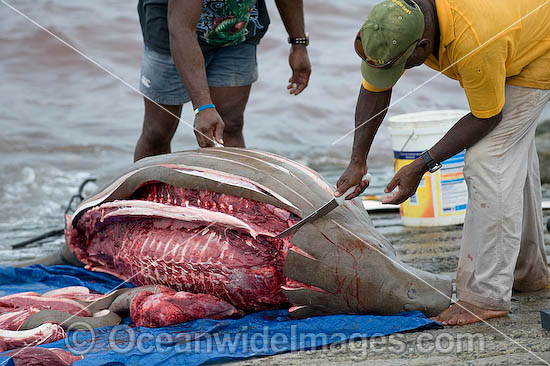
Dugongs are hunted for their meat and blubber throughout the wildlife range. The sea grass they feed on are in danger due to Eutrophication caused by Agriculture and Industrial run off. As they feed in shallow water, they are many a times hit by motorised vehicles. Due to there huge size they have only a few predators, namely sharks, killer whales and saltwater crocodiles.
The US and japanese govt. plan to set up a military base on a coral reef near Henoko, in Nago country, Okinawa. This faced much protest from the Okinawans as this would destroy the local and natural environment of the Dugong. Greenpeace stepped in when the work recommenced in 2007.
Around the waters of Papua New Guinea natives have been known to hunt Dugong and its predaors for ages.
Diet: Herbivore
Group Name :
Herd
Weight:
510 to 1100 Lbs
Size:
8-10 Feet
Dugong' Size relative to a 6ft man: